

Every retailer is aware of the frustration when a customer leaves unhappy, while a colleague stands...
Ireland’s customer experience has reached its highest level in nine years. The latest CXi research from the CX Academy found that 64% of the organisations surveyed improved their customer experience scores this year.
Credit unions remain at the top. Pharmacies, supermarkets, financial services and retailers performed strongly. Fast food, however, was the exception. KFC fell 77 places, Subway dropped 69, Burger King fell 45, and McDonald’s dropped 41. The restaurant sector was the only one whose average CX score declined. Customers complained about poorer food quality, incorrect orders, cold food, higher prices and declining service.
That raises an interesting question:
Have we become so good at making fast food efficient that we have made it harder to maintain quality?
The customer journey got easier. The operation got harder.
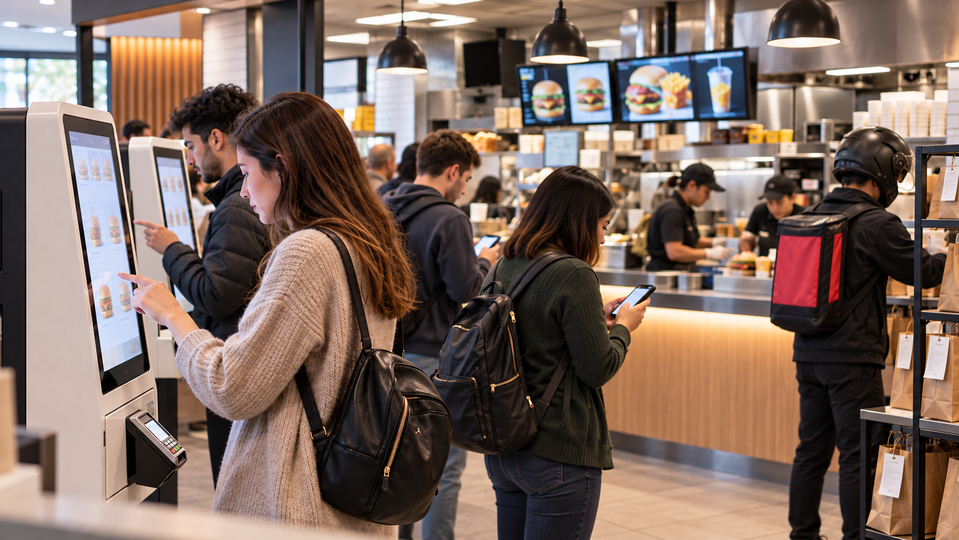
Walk into a modern fast-food restaurant, and ordering has never been simpler. You can use a touchscreen, order via an app, customise your meal, or have it delivered without speaking to anyone.
All of those things can improve the customer experience, but look behind the counter. The restaurant may now handle orders simultaneously from the front counter, self-service kiosks, its own app, and several delivery platforms. One part of the customer journey has become easier, but the operation supporting it has become more complex.
When things go wrong, customers do not particularly care where the failure occurred. The kiosk may work perfectly, but if the meal is assembled incorrectly, sits too long, arrives cold, or is missing a drink, the customer experiences a single failure. A beautifully designed digital ordering journey does not compensate for cold chips.
Speed is not the same as success
Fast food has always prioritised speed, which makes sense. But an order delivered in four minutes rather than six is not an improvement if something is missing. A kiosk that reduces ordering time does not help if it sends more demand into a kitchen that cannot absorb it. A delivery platform may increase sales, but it may not increase customer value if it overwhelms the restaurant and damages the in-store experience.
Efficiency is what the business measures. Experience is what the customer receives.
The two should reinforce each other, but they don't automatically.
Customers may have changed too
There is another possibility. Perhaps fast-food service has not deteriorated as dramatically as the rankings suggest. Perhaps customers have become less forgiving. Fast food has traditionally offered a clear bargain: quick, predictable and relatively inexpensive food.
As prices rise, that bargain changes. A customer paying considerably more may be less tolerant of missing items, cold food, or poor service. “Good enough” becomes harder to accept when the bill no longer feels cheap. Customers judge the experience against expectations, and higher prices usually raise those expectations too.
Technology can create more human moments
There is an irony here. Technology is often introduced to reduce the need for human intervention. Yet when something goes wrong, customers almost always want a person. The kiosk cannot apologise, and the app cannot recognise that someone has waited too long. That moment lands with the colleague.
Increasingly, the human enters the journey only after something has already failed. The easy interactions disappear. The colleague receives the missing item, the wrong order, the delay, and the frustrated customer. That means the human role becomes more important precisely when the operation appears to need fewer people.
What should leaders measure?
Transaction time, labour productivity, sales per hour and digital adoption still matter. But I would also like to know:
- How often is the order correct?
- How often does a customer need somebody to fix it?
- How long has food been waiting before collection?
- What happens when demand from several channels peaks at once?
- Do colleagues have enough capacity to acknowledge and recover the customer in front of them?
Those measures tell us whether efficiency is actually reaching the customer. The best fast-food operations have always relied on people. Someone notices the queue, spots the missing item, and decides to remake the meal rather than argue. Someone says, “Sorry about that, I’ll sort it.”
Those moments rarely appear on an operations dashboard, yet they can determine whether a customer leaves frustrated or satisfied. That is why I agree that people remain central to customer experience, but I would go one step further:
We cannot ask colleagues to provide the human touch while continually designing operating models that make it harder for them to deliver it.
Fast food can become faster, ordering can become easier, and businesses can process more transactions. But if the meal is cold, the order is wrong, and nobody has time to fix it, customers are unlikely to care how efficient the operation was.
Efficiency is what the business measures. Experience is what the customer remembers.
Continue the conversation
This article explores why faster, more digital fast-food experiences don't always translate into happier customers. In the fuller Substack version, I explore the latest Irish CXi findings in more depth, including the role of changing customer expectations, operational complexity and the increasing importance of frontline recovery when technology and processes fall short.
Read the full Substack article →Part of the RetailCX Blueprint, a growing collection of practical ideas, frameworks and real-world examples to help organisations deliver better customer and colleague experiences.
At RetailCX, we specialise in helping organisations harness leadership and employee engagement to enhance customer experiences. Contact us to learn how we can support your journey toward a more innovative and customer-centric future.