


You're standing at a supermarket customer service desk and the customer in front wants a refund on...
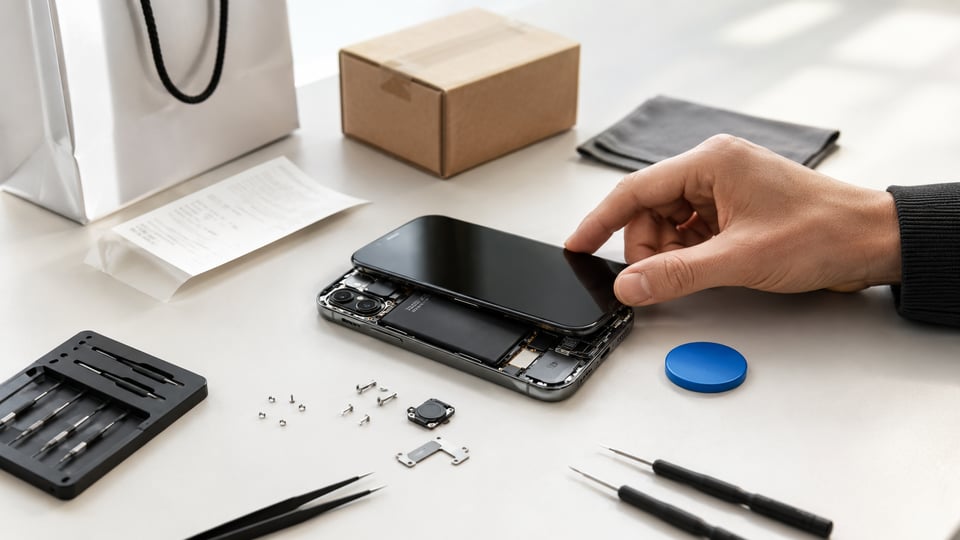
When the retailer owns the customer relationship but not the repair
A customer enters a mobile phone shop with a non-functioning handset. The screen may have failed, the phone may no longer charge, or it may have developed an intermittent fault that is difficult to diagnose. From the customer’s perspective, the expectation is straightforward:
“I bought this from you. It doesn’t work. Please fix it.”
Behind the counter, the situation may be more complex. The retailer may own the customer relationship but not control the repair process. The manufacturer may require the handset to be sent to its own repair facility or to an authorised repair partner, who then controls the diagnosis, parts availability, repair decision and timescale. The retailer receives the customer’s frustration but may have limited influence over the outcome.
I encountered this frequently during my time at O2, and it taught me a lesson that will become even more relevant as Ireland’s (and the EU's) new right-to-repair rules take effect:
Customers experience one problem. Organisations respond with several sets of responsibilities.
Somewhere between those responsibilities, ownership can be lost.
The repair problem at O2
Mobile phone repairs were among the most challenging customer journeys to manage. Customers usually came to O2 first because they had bought the handset from us and often maintained an ongoing service relationship with us. However, the repair route depended heavily on the manufacturer. Some manufacturers required repairs to be completed within their own systems or through approved repair partners. This may have been necessary to protect technical standards, warranties and product integrity.
But it created a difficult operating model. O2 managed the customer relationship, while the manufacturer or repair agent controlled much of the resolution. The handset might need to be packaged, collected, transported, logged, assessed and placed in a repair queue. Each hand-off increased the risk of delay, uncertainty or a communication breakdown.
Customers wanted to know:
- Had the phone arrived?
- Had it been assessed?
- Was the repair covered?
- Were parts needed?
- When would it be returned?
They asked O2, even though the answers lay elsewhere. Each organisation might believe it had completed its part correctly, but the customer could still be left without a working phone and without confidence that anyone was taking responsibility.
A process can be compliant at every hand-off and still feel completely broken to the customer.
Why a broken phone mattered commercially
At O2, a mobile phone was not simply a product we sold. It was the means by which customers accessed our service. Without a working handset, customers could not make calls, send messages or use mobile data. This meant the repair journey affected both network revenue and customer satisfaction. Both the customer and O2 wanted the connection restored quickly.
The fastest route back to customer value was also the fastest route to commercial value.
We therefore sought to regain as much control as possible. Where appropriate, we used designated repair agents with whom we had a direct relationship. This gave us greater influence over service levels, information and escalation. In our busiest stores, we went further.
We established an in-house repair service staffed by specially trained technicians who could diagnose and repair many handsets on site. This created a much better experience. The phone did not always need to leave the store. The technician could assess the fault, explain the problem, and often complete the repair without the communications and delays associated with an external process.
Not every handset could be repaired in store, but handling even a proportion of repairs internally reduced customer effort, shortened downtime, improved visibility for colleagues, and restored network access more quickly. It combined a good customer experience with sound commercial logic.
A new right, and an old operating problem
Ireland’s new right-to-repair rules give consumers more repair options for a range of products, including mobile phones, tablets, domestic appliances, televisions, vacuum cleaners, data-storage devices and some forms of electric transport. The intention is positive. Consumers should have more opportunities to keep products working rather than replacing them.
But legislation can create a right without ensuring a straightforward customer journey. A customer may still need to determine whether the issue is an original product fault, normal wear and tear, accidental damage or misuse. The retailer may believe the manufacturer is responsible. The manufacturer may believe the retailer is responsible. The repairer may need to inspect the product before deciding. The customer can quickly become the person carrying information and responsibility between organisations.
They may hear: “Contact the retailer", ” Speak to the manufacturer”, “The manufacturer says it is the retailer’s responsibility”.
The organisations may see this as identifying the correct legal route. The customer experiences it as being passed around from one to another.
The most frustrating part of a repair may not be the repair itself, but proving which organisation is responsible for it.
Legal responsibility is not experienced responsibility
Retailers understandably need clarity on the limits of their legal obligations. They cannot take responsibility for every damaged product, absorb every repair cost, or override every manufacturer's process. But legal responsibility is only one part of the customer experience.
There is also experienced responsibility. This is the organisation the customer believes should help. It is shaped by the relationship, not just the contract.
- Where did the customer buy the product?
- Whose shop can they visit?
- Whose brand do they recognise?
- Who recommended the product?
- Who has the ongoing relationship?
In many cases, the retailer remains the natural point of contact even when the manufacturer is responsible for the repair. That does not mean the retailer must perform or fund the repair. It does mean that simply directing the customer to a website or telephone number may feel inadequate. Customers do not separate the purchase, product and problem into distinct contractual categories. They experience one relationship.
Control, influence and ownership
One lesson from O2 was that organisations often confuse three different ideas.
Control means being able to decide what happens.
Influence means having a direct relationship with those who control the process.
Ownership means remaining accountable to the customer until the issue is resolved.
A retailer may not control a manufacturer’s repair centre, but it can still increase its influence through service agreements, shared information, repair tracking and clear escalation routes. Even when control and influence are limited, it can demonstrate ownership through clear explanations, regular updates and practical support.
You cannot credibly own the customer relationship while disclaiming responsibility for every part of the journey you do not control.
The colleague caught in the middle
The success of the new repair regime will depend heavily on frontline colleagues. Customers will not arrive quoting the legal distinction between an inherent fault and accidental damage; they will arrive with a broken product and a degree of frustration. Colleagues will need more than a brief compliance update. They will need clear guidance, access to product and purchase information, repair contacts, escalation routes, and visibility into what happens after the product leaves the store.
Without these tools, frontline teams become the buffer between the customer and a fragmented repair system. They absorb frustration caused by policies they did not design and processes they cannot influence. That is not empowerment; it is exposure.
When organisations fail to design ownership, frontline colleagues inherit the ambiguity.
The commercial case for ownership
At O2, the commercial connection was immediate. Repairing the handset restored the customer’s access to the network and revenue. In other sectors, the benefit may be less direct, but it remains significant. Customers buying a high-value product are also buying confidence in what will happen after the sale.
A retailer that manages repairs well reduces the perceived risk of the next purchase. A retailer that retreats behind the manufacturer’s process may complete the first transaction but damage the prospect of a second.
The sale generates revenue once. The repair experience determines whether the customer will trust you for future purchases.
My final thought
Ireland’s new rules should make it easier to repair products that might otherwise be discarded, which is a positive development. But a right to repair does not automatically ensure a good repair experience. The real test will be whether retailers, manufacturers and repair partners can make their separate responsibilities feel joined up from the customer’s perspective.
During my time at O2, the best repair experiences came when we reduced the distance between the customer and the person able to solve the problem. Sometimes that meant working directly with a trusted repair partner. In our busiest stores, it meant placing trained technicians on site. Fewer hand-offs led to greater clarity, speed and reassurance. Most importantly, customers regained use of their phones and returned to using the service.
Customers do not want to understand the repair ecosystem. They want someone to take ownership of restoring their product.
Continue the conversation
This article explores why the right to repair will test the relationship between retailers, manufacturers and repair partners. In the fuller Substack version, I draw more extensively on my experience at O2 and examine the difference between legal responsibility, operational control and genuine ownership of the customer experience.
Read the full Substack article →This is part of the RetailCX Blueprint – a growing collection of practical ideas, frameworks and real-world examples to help organisations create better customer and colleague experiences.
At RetailCX, we specialise in helping organisations harness the power of leadership and employee engagement to enhance customer experiences. Contact us to learn how we can support your journey toward a more innovative and customer-centric future.